Get Started Making Money with 3D Printing
Most people who buy a 3D printer start the same way. They print parts for friends, create a few hobby projects, and slowly realise something: people will pay for this.
Engineers need prototypes fast. Businesses need small production runs without the cost of injection moulding. Makers want components that do not exist off the shelf. The demand is real.
What most printer owners are missing is not customers — it is a business.
The 3D printing operations that generate consistent revenue share three things: a defined niche, products people actually need, and a process that turns enquiries into orders. Get those right, and a single printer can turn into a reliable revenue stream. Here is how successful 3D printing businesses approach it.
1. Pick a Niche and Own It
Printing everything for everyone is a race to the bottom. The businesses that stick around specialise.
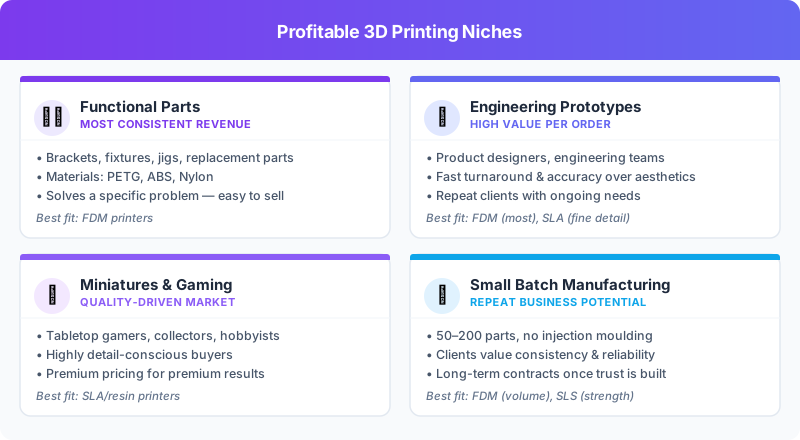
A clear niche sharpens your marketing, deepens your material and machine expertise, and brings customers back. Here are the ones that consistently generate revenue:
- Functional parts. Brackets, replacement components, fixtures, jigs. Materials like PETG, ABS, and nylon hold up in real-world conditions. These prints solve a specific problem, which makes them straightforward to sell.
- Engineering prototypes. Product designers and engineering teams need test parts quickly and often. They care about dimensional accuracy and fast turnaround, not surface aesthetics. FDM handles most of this work; SLA steps in when fine detail matters.
- Miniatures and gaming terrain. Resin printing opened up a market that did not exist at scale before. Tabletop gamers want high-detail miniatures and terrain, and they know the difference between a good print and a mediocre one. If you are running an SLA setup, this niche rewards quality.
- Small batch manufacturing. When a company needs 50 enclosures or 200 brackets and injection moulding does not make sense at that volume, 3D printing is the practical answer. These clients value consistency and reliability above everything else.
The right niche is the one where your equipment, materials, and process deliver results you can repeat.
2. Decide What Products or Services You Will Sell
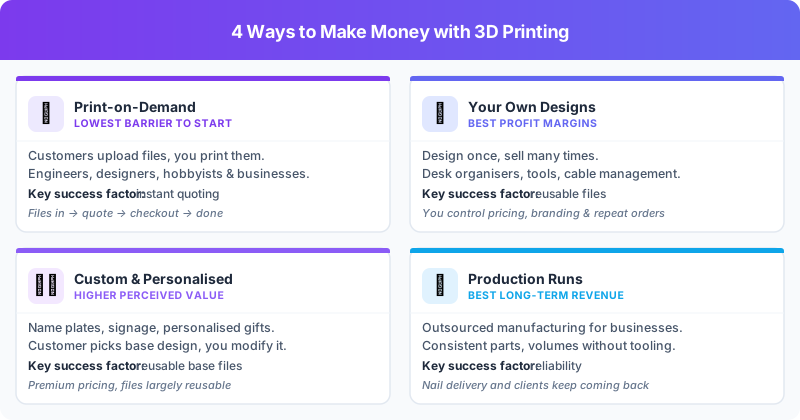
You have decided on your niche — now decide how you are going to make money from it. Most 3D printing businesses run on one of four models.
- Print-on-demand services. Customers send files, you print them. Engineers, designers, hobbyists, and small businesses all use this. The critical variable is speed. A customer who uploads a file and waits two hours for a manual quote will often find someone else. This is where instant quoting changes the outcome. RapidQuote3D lets customers upload a model, select their material, configure settings, and get accurate pricing on the spot. The order is placed in minutes, not hours.
- Your own designs. Design it once, sell it many times. Desk organisers, tool holders, cable management, replacement parts — these are products you control from pricing to branding. Margins are better, and repeat orders happen without you lifting a finger.
- Custom and personalised products. Name plates, signage, personalised gifts. Customers choose a base design and you modify it. The perceived value is higher than a standard print, and the files are largely reusable.
- Low-volume production runs. Outsourced manufacturing for businesses that need consistent parts at volumes that do not justify tooling costs. These clients want reliability. Nail that, and they will keep coming back.
3. Choose the Right Printing Technology
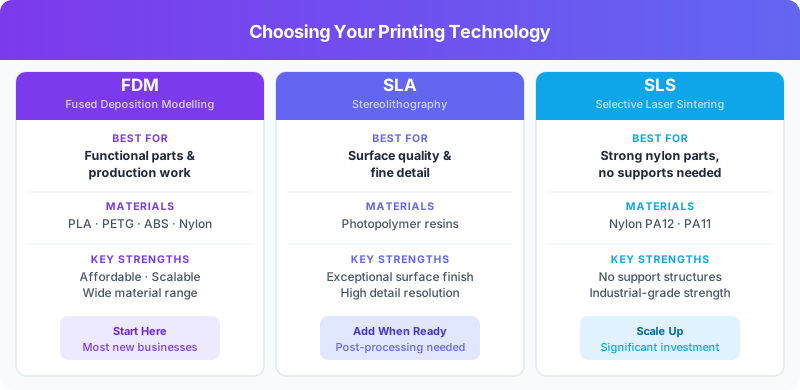
The right equipment depends entirely on what you are printing.
FDM handles the bulk of functional and production work. PLA for prototypes, PETG and ABS for parts that need strength or heat resistance, nylon for high-load engineering applications. A well-dialled FDM setup can run at scale without constant intervention.
SLA is the right call when surface quality and fine detail are the product. Miniatures, jewellery prototypes, dental models. Post-processing adds time, but the visual result is in a different category from FDM.
SLS produces strong nylon parts without support structures and is standard at larger service bureaus, but it requires a significant capital investment. Most new businesses start with FDM or SLA and add capacity as revenue grows.
4. Build a Process That Does Not Rely on You for Every Step
This is where most print businesses hit a wall.
In the early days, quoting manually works. You receive a file, estimate material and machine time, and send an email with a price. Fine for a few enquiries a week. Unsustainable at twenty.
The problems compound quickly: slow response times, inconsistent pricing, long email threads, enquiries that go cold, abandoned quotes you never followed up. Every one of those is lost revenue.
RapidQuote3D was built to close that gap. Customers upload a file, configure materials and settings like infill percentage or surface finish, and receive an accurate quote instantly. No waiting. No back-and-forth.
The platform goes further than quoting. A configurable AI assistant handles common questions about material properties and print configurations — the kind of questions that usually land in your inbox at 9pm. Educational prompts walk customers through decisions like layer height and infill without them needing to contact you. Customers who understand what they are ordering convert at a higher rate.
After checkout, automated email workflows handle confirmations, production updates, and follow-ups. Abandoned quotes trigger recovery sequences. Referral programmes and promotions run without manual input. Order history lives in one dashboard, so returning customers can log in and reorder previous jobs in a few clicks.
Less time on admin. More time printing.
5. Price for Profitability, Not Just to Win the Job
Underpricing is the most common mistake new print businesses make. A quote that does not account for all real costs is not competitive. It is just slow financial damage.
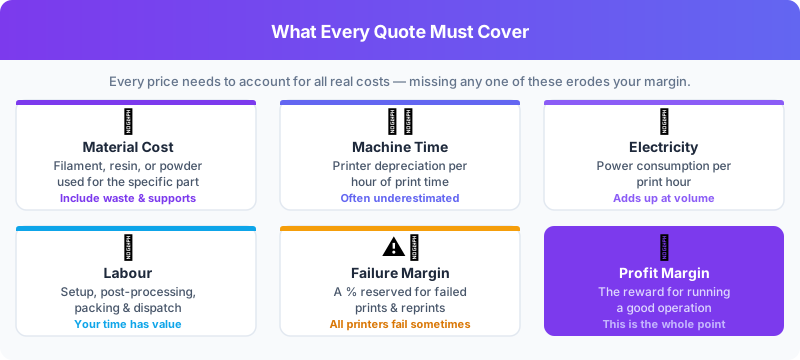
Every price needs to cover material usage, machine time, electricity, labour, post-processing, a failure margin, and a profit margin. Automated quoting calculates these variables consistently, which also removes the negotiation problem. The price is the price.
6. Build a Simple Marketing Engine
A well-run operation with no inbound enquiries does not grow. A few marketing channels that consistently work include:
- Search traffic. Buyers search for terms like "custom 3D printing near me" or "FDM prototype printing." Optimised service pages capture this without ongoing ad spend.
- Maker communities. Communities like Reddit, Printables, and Discord contain people actively looking for printing services. Being genuinely useful in these spaces builds trust faster than advertising.
- Social content. 3D printing is visual. Time-lapses, finished parts, before-and-after posts. It is easy content that demonstrates capability better than any product description.
- Repeat customers. The easiest order to win is one from someone who has already bought from you. RapidQuote3D supports reordering directly from order history, which reduces friction for returning clients.
Converting Enquiries Into Revenue
Most 3D printing businesses do not have a demand problem. They have a conversion problem. Files get uploaded, quotes go out, and a percentage of potential orders quietly disappear: unanswered questions, checkout friction, no follow-up.
RapidQuote3D was developed inside a high-volume production environment to solve exactly that. Instant quoting, AI-assisted customer guidance, automated follow-ups, cart recovery, and order management in one place, built specifically around how 3D printing businesses grow and scale.
Setup takes just 20 minutes. There is a 14-day free trial if you want to test it against your current process, or you can book a call with one of the founders to walk through how it fits your workflow.
Ready to Automate Your 3D Printing Quotes?
Start your 14-day free trial and see how RapidQuote3D can transform your business.
Start Free Trial